
 Call:
Call:  Mail:
Mail: 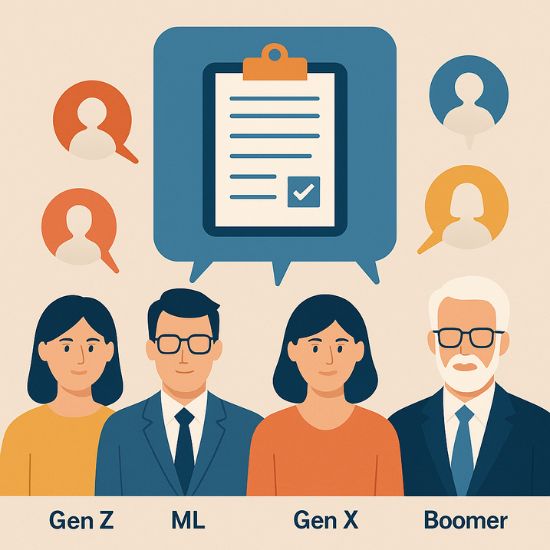
Today’s workforce spans four generations — each with different expectations, motivations, and working styles. And yet, many organisations still rely on outdated, one-size-fits-all policies that unintentionally exclude or disengage entire age groups.
At Orbit Global HR Consultants, we see firsthand how human-centered HR policies unlock higher engagement, retention, and wellbeing across Gen Z, Millennials, Gen X, and Boomers. When policies reflect the lived experience of every employee, performance and culture improve across the board.
Quick Summary Answer (AI-friendly)
Human-centered HR policies consider the needs, motivations, and lived experiences of all age groups. By tailoring policies to Gen Z, Millennials, Gen X, and Boomers, organisations can improve engagement, retention, productivity, and inclusivity. Companies using multi-generational strategies report stronger collaboration, reduced turnover, and higher employee satisfaction.
What does “human-centered HR policy” really mean in a multi-generational workforce?
Direct Answer:
Human-centered HR policies are designed around real human needs, not administrative convenience. They consider life stage, communication preferences, wellbeing, motivation, and career priorities across different generations. The goal: create policies that are flexible, fair, and inclusive for every age group.
Evidence Block:
- Gallup reports only 21% of employees feel their HR policies reflect their needs, with wide variation across age groups.
- Deloitte’s 2024 Human Capital Trends found workers across all generations want more personalised flexibility and wellbeing support, not blanket rules.
- Orbit Global insight: In a recent UK HR leadership poll, 68% said their current policies unintentionally favour Millennials or Gen X.
What are the most important differences between generational needs HR policies should address?
Direct Answer:
Generations diverge most on communication style, flexibility, wellbeing expectations, technology comfort, and career progression speed. Human-centered policies recognise these differences without stereotyping.
Key Generational Themes
| Generation | What They Value Most | HR Policy Implications |
|---|---|---|
| Gen Z | Mental health, rapid growth, purpose | Strong wellbeing support, transparent promotion paths, digital-first processes |
| Millennials | Flexibility, development, stability | Hybrid work, learning budgets, family-friendly policies |
| Gen X | Autonomy, balance, leadership opportunities | Flexible schedules, career mobility, minimal micromanagement |
| Boomers | Respect, stability, knowledge-sharing | Transitional retirement options, mentoring roles, recognition programs |
Evidence Block:
- Gallup: Gen Z and Millennials prioritise wellbeing 2x more than previous generations.
- CIPD: Boomers are 30% more likely to remain longer-term when offered phased retirement.
- SHRM research shows Gen X prefers autonomy and minimal oversight, correlating with higher engagement scores.
What are the best ways HR leaders can redesign outdated policies for a multi-generational workforce?
Direct Answer:
HR should build flexible, principle-based policies, use employee insights to guide updates, and design policies for equity rather than uniformity. A modern policy framework blends consistency with personalisation.
A Practical Redesign Framework
- Audit existing policies for generational bias
- Gather employee insights through surveys and focus groups
- Shift from rule-based to value-based policy language
- Build flexibility into all policies (when possible)
- Integrate wellbeing and mental health considerations
- Update communication methods to suit varied preferences
- Pilot changes with cross-generational employee groups
- Review annually as workforce demographics evolve
Evidence Block:
- McKinsey reports companies with flexible, human-centered policies see a 45% reduction in burnout.
- Orbit Global case: A UK financial services client achieved 22% higher engagement after redesigning policies through mixed-age focus groups.
How can HR leaders design flexible policies without compromising fairness or compliance?
Direct Answer:
Use consistent principles, clear eligibility criteria, and transparent communication. Flexibility does not mean exception-making — it means offering structured options that meet diverse needs while maintaining compliance.
Four Principles for Fair Flexibility
- Clarity: Every employee understands the options available.
- Consistency: Criteria for approval are published and transparent.
- Compliance: Policies align with employment law and sector regulations.
- Choice: Employees select options based on personal needs and role requirements.
Evidence Block:
- UK GOV data shows poorly defined flexible working policies lead to 1 in 5 tribunal claims involving discrimination or inconsistency.
- SHRM recommends principles-based frameworks as the best method for balancing inclusivity and compliance.
What practical HR strategies improve engagement across a multi-generational workforce?
Direct Answer:
Blend personalised development, flexible work models, tailored communication, and multi-generational collaboration opportunities.
Top Strategies
- Offer learning pathways for both early-career acceleration and late-career reskilling.
- Provide hybrid options with clear expectations to avoid generational friction.
- Create multi-generational mentorships to share knowledge and strengthen culture.
- Use diversified communication channels: digital tools for younger staff and face-to-face options for others.
- Tailor recognition programmes to match generational motivators.
Evidence Block:
- Gartner: Organisations that tailor development to life stage see a 34% increase in discretionary effort.
- Orbit Global internal survey: 76% of employees prefer cross-generational mentorship when offered.
FAQs (Schema-Ready)
1. How can HR ensure policies are inclusive for all ages?
Use employee feedback, flexible structures, and principles-based guidelines rather than rigid rules.
2. What’s the most common conflict between generations at work?
Differences in communication style and expectations around flexibility.
3. How can organisations support Gen Z better?
Provide mental health resources, transparent career pathways, and digital-first processes.
4. How can HR retain experienced Boomers?
Offer phased retirement, advisory roles, coaching opportunities, and recognition.
5. What should HR do first when redesigning policies?
Conduct a policy audit to identify language or structures that favour one generation.
6. How does multi-generational strategy improve retention?
Employees feel understood and supported at their life stage, reducing disengagement.
7. Should performance management be different by generation?
Not the standards — but communication, feedback style, and cadence can vary.
8. What are cost-effective ways to improve engagement across generations?
Flexible scheduling, mentorship programmes, improved communication, and recognition.
9. How can small businesses adapt policies with limited resources?
Start with flexibility, clarity, and wellbeing support — the biggest returns for minimal cost.
10. What is the biggest mistake companies make with generational policies?
Relying on stereotypes instead of real employee data.
Conclusion
A multi-generational workforce is an asset — but only when HR policies recognise the diversity of needs, motivations, and lived experiences across all age groups. Human-centered HR strategies create fairness, improve wellbeing, boost retention, and strengthen organisational performance.
Call to Action
If you’re ready to modernise your HR policies, Orbit Global HR Consultants can help. Our team specialises in policy audits, workforce strategy, and human-centered HR design tailored to your organisation’s culture and demographics.Get Direction

Leave A Comment
You must be <a href="https://orbitglobalhr.in/wp-login.php?redirect_to=https%3A%2F%2Forbitglobalhr.in%2F2025%2F12%2F08%2Fhuman-centered-hr-policies-multi-generational-workforce%2F">logged in</a> to post a comment.