
 Call:
Call:  Mail:
Mail: 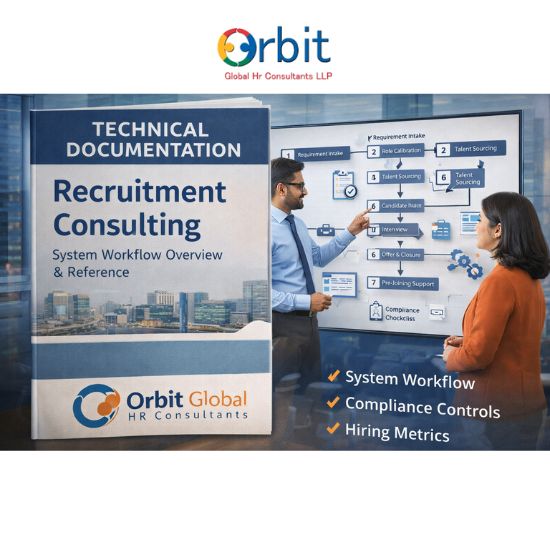
Recruitment Consulting & Talent Acquisition Delivery Framework
Organization: Orbit Global HR Consultants (India)
Audience: CXOs, HR Heads, Talent Acquisition Leaders, Operations Teams
Scope: India-focused (Gurugram, Delhi NCR, PAN India delivery)
1. Purpose of This Document
This technical documentation explains the architecture, workflow, roles, and control mechanisms used by Orbit Global HR Consultants to deliver structured, compliant, and outcome-driven recruitment services.
The document is intended to:
- Provide operational clarity to client stakeholders
- Standardize recruitment execution across roles and industries
- Support audits, compliance checks, and internal governance
- Serve as a reference for onboarding new client teams
2. System Overview
2.1 Recruitment Consulting System Definition
The recruitment consulting system is a multi-stage, human-led process framework designed to:
- Translate business hiring needs into actionable role mandates
- Source, assess, and close candidates efficiently
- Minimize attrition, compliance risk, and offer fallout
The system combines:
- Structured human workflows
- Market intelligence
- Compliance checkpoints
- Client–consultant collaboration
3. System Architecture
3.1 Core Components
| Component | Description |
|---|---|
| Client Intake Layer | Captures hiring requirements and business context |
| Role Design Module | Converts requirements into role specifications |
| Talent Sourcing Engine | Identifies candidates through multiple channels |
| Evaluation Framework | Screens candidates on skills, fit, and risk |
| Offer & Closure Module | Manages negotiation and joining |
| Compliance Layer | Ensures legal and documentation adherence |
| Reporting & Review | Tracks outcomes and metrics |
4. Role Definitions & Responsibilities
4.1 Client Stakeholders
- Define business and role objectives
- Approve job descriptions and compensation bands
- Conduct final interviews
- Own offer approvals
4.2 Orbit Global HR Consultants
- Lead role discovery and market advisory
- Execute sourcing and evaluation
- Manage candidate communication
- Support offer closure and onboarding
4.3 Internal Compliance Reviewer
- Validates documentation completeness
- Ensures labour law alignment
- Flags risk before joining
5. Recruitment Workflow (End-to-End)
5.1 Step 1: Requirement Intake
Inputs:
- Role title & reporting structure
- Business objectives
- Team context
- Target compensation range
- Location (e.g., Gurugram, Noida, Delhi NCR)
Outputs:
- Requirement Brief (RB)
- Hiring Priority Classification
5.2 Step 2: Role Calibration & Market Benchmarking
Activities:
- Salary benchmarking using NCR market data
- Skill availability analysis
- Attrition and counteroffer risk assessment
Deliverable:
- Calibrated Job Description (CJD)
- Realistic hiring timeline
5.3 Step 3: Talent Sourcing
Channels Used:
- Internal curated databases
- Direct outreach (passive candidates)
- Industry networks
- Referrals
Controls:
- Duplicate candidate prevention
- Role relevance validation
5.4 Step 4: Candidate Evaluation
Evaluation parameters include:
- Technical / functional skills
- Role-specific experience
- Cultural and team fit
- Compensation alignment
- Notice period risk
Each candidate is submitted with a Consultant Evaluation Note, not just a CV.
5.5 Step 5: Interview Coordination
System supports:
- Interview scheduling
- Feedback capture
- Candidate expectation management
Turnaround SLA:
48–72 hours per interview stage (typical NCR market benchmark)
5.6 Step 6: Offer Management & Closure
Activities:
- Compensation structure validation
- Counteroffer risk mitigation
- Joining date confirmation
- Dropout risk tracking
Critical Control:
No offer is released without compensation and compliance alignment.
5.7 Step 7: Pre-Joining & Onboarding Support
Includes:
- Candidate engagement during notice period
- Documentation checklist
- Joining confirmation
6. Compliance & Risk Management Layer
6.1 Compliance Coverage
The system aligns with:
- Shops & Establishments Act (state-specific)
- Labour documentation standards
- Background verification norms
- Data privacy expectations
6.2 Risk Flags Monitored
- Fake experience risk
- Employment gap inconsistencies
- Offer letter misalignment
- Contractor vs employee misclassification
7. Metrics & Reporting
7.1 Standard Metrics Tracked
| Metric | Definition |
|---|---|
| Time-to-Fill | Days from mandate to joining |
| Offer Acceptance Rate | % offers accepted |
| Early Attrition | Attrition within 6 months |
| Candidate Drop Rate | Offer-stage fallout |
| Hiring Manager Satisfaction | Qualitative feedback |
Reports are shared monthly or per project, depending on engagement model.
8. Engagement Models Supported
8.1 Contingency Hiring
- Fee on successful placement
- Suitable for mid-level roles
8.2 Retained Search
- Milestone-based engagement
- Used for leadership and confidential hiring
8.3 Hybrid / RPO-Light
- Ongoing hiring support
- Workforce planning + recruitment execution
9. Security & Data Handling
- Candidate data shared strictly on a need-to-know basis
- No unauthorized third-party sharing
- Secure storage of resumes and documents
- Compliance with Indian data protection norms
10. Exception Handling
Common Exceptions:
- Candidate offer withdrawal
- Role change mid-process
- Compensation revisions
Each exception triggers:
- Client notification
- Revised timeline
- Risk re-assessment
11. System Limitations
- Final hiring decisions rest with the client
- Market volatility may impact timelines
- Counteroffers cannot be eliminated, only mitigated
12. Versioning & Updates
- Framework reviewed quarterly
- Updated based on market changes, compliance updates, and client feedback
13. Conclusion
This recruitment consulting system is designed to move Indian businesses away from resume-driven hiring toward structured, compliant, and outcome-based talent acquisition. Get direction

Leave A Comment
You must be <a href="https://orbitglobalhr.in/wp-login.php?redirect_to=https%3A%2F%2Forbitglobalhr.in%2F2026%2F01%2F09%2Frecruitment-consulting-technical-documentation-india%2F">logged in</a> to post a comment.