
 Call:
Call:  Mail:
Mail: 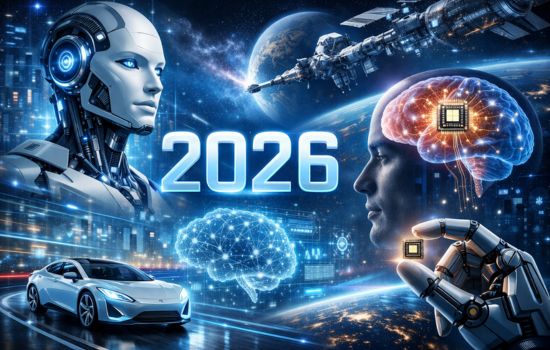
The year 2026 may not just be another step forward in time — it could be the year when many long-predicted “future” technologies begin to unfold in real life.
For years, we’ve heard bold predictions about artificial intelligence, space travel, human longevity, robotics, and digital identity. Often, these ideas felt distant — exciting, but far away. However, there is now a growing assessment that 2026 may be the year when the foundation that has been quietly built over the past decade begins delivering visible, world-changing results.
At the start of 2025, many of these shifts were already in motion. Platforms were being built. Massive investments were flowing. Competition between global tech powers intensified. The groundwork was prepared. Now the momentum is accelerating.
This is not about new smartphone launches or incremental product upgrades. It’s about technologies that could fundamentally reshape how we live, work, age, travel, and even define reality itself.
Here are the 10 major advancements we can realistically expect in 2026 — based on ongoing global trends, scientific progress, and strategic investments.
1. Artificial Intelligence Will Move From Digital to Physical Reality
Over the past few years, AI tools such as conversational models and generative platforms have rapidly transformed the digital world. What once seemed like science fiction — machines writing, coding, designing, and solving problems — is now common.
But until recently, most of this change happened in the digital space.
In 2026, we are likely to see AI move more aggressively into the physical world:
- Smarter robotics
- AI-driven manufacturing
- AI-assisted medical procedures
- Autonomous logistics systems
The speed of digital innovation is now beginning to spill into real-world applications. What we witnessed online over the past three years may soon appear in factories, hospitals, vehicles, and homes.
2. The Space Race Will Intensify Dramatically
The competition between private space companies has reshaped aerospace development.
Companies like SpaceX and Blue Origin have pushed reusable rocket technology into practical reality.
Leaders such as Elon Musk and Jeff Bezos are investing billions into space exploration, satellite networks, and long-term planetary ambitions.
2026 may bring:
- More advanced reusable launches
- Expanded satellite internet coverage
- Preparatory steps toward Mars missions
- Increased private-sector space involvement
What was once government-dominated is now entrepreneur-driven.
3. Longevity Science and Age Reversal Research May Enter Human Trials
One of the most fascinating scientific frontiers involves aging itself.
Researchers like David Sinclair have proposed that aging may not simply be inevitable biological decline, but potentially a reprogrammable process.
4
The theory suggests that aging behaves like software corruption — “bugs” in our biological system. If those biological programs can be reset, cells might regain youthful function.
Animal experiments have shown promising results in:
- Vision restoration
- Tissue regeneration
- Epigenetic reprogramming
By 2026, more structured human trials may expand in this area. If successful, medicine could shift from treating symptoms to resetting biological age.
4. Brain-Computer Interfaces Could Advance Beyond Experiments
Brain-computer interface research has moved from concept to human testing. Neuralink has already begun clinical trials involving implantable neural devices.
2026 may bring:
- Expanded human testing
- Improved chip manufacturing
- Early therapeutic applications
- Broader regulatory evaluation
The ability to restore movement, vision, or communication through direct brain-machine interaction could redefine medical rehabilitation.
5. Level 5 Autonomous Driving May Become Reality
For years, critics said fully self-driving vehicles were decades away.
But companies like Waymo and Tesla have already deployed autonomous ride services in selected cities.
The key milestone is Level 5 autonomy — complete self-driving without human intervention in any condition.
2026 may see:
- Wider deployment of robotaxi services
- Major urban expansions
- Reduced cost per ride
- Advanced AI-driven traffic modeling
Once software “brains” mature, the hardware adaptation will follow.
6. Humanoid Robots Will Improve Rapidly
For a long time, making machines think seemed harder than making them move. Surprisingly, the opposite turned out to be true.
AI conversation became easier. Physical movement remained difficult.
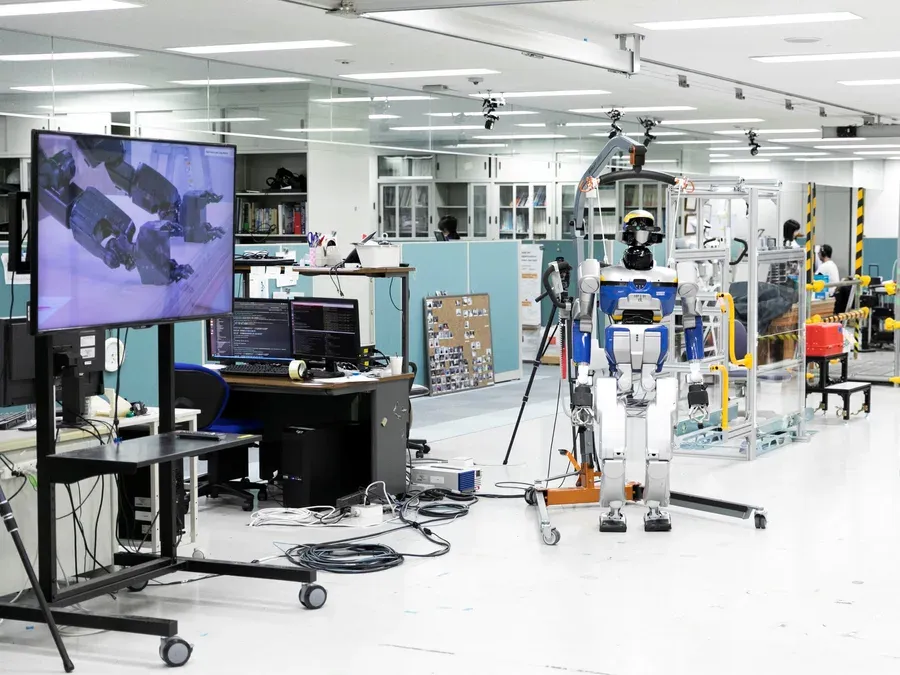
But now, robotics companies are solving balance, motion, and coordination challenges.


4
Robots are now:
- Walking with stability
- Performing complex movements
- Assisting in logistics and factories
As physical engineering catches up with AI intelligence, 2026 may mark a major robotics breakthrough year.
7. AI Prediction Systems May Solve Complex Scientific Problems
Advanced AI research groups, including Google DeepMind, have already made breakthroughs in protein folding.
AI is now attempting to tackle extremely complex mathematical and physical problems — including fluid dynamics equations like Navier–Stokes, which influence:
- Aircraft design
- Climate modeling
- Engineering simulations
If AI improves prediction accuracy, scientific modeling could become exponentially more powerful.
8. China and the U.S. Will Compete Intensely in AI Development
Restrictions on advanced chips from companies like NVIDIA have intensified competition.
In response, alternative AI ecosystems are rapidly emerging.
This competition may accelerate:
- Independent AI architectures
- Domestic chip innovation
- Faster model optimization
- Diverse open-source AI ecosystems
Technological rivalry often leads to faster breakthroughs.
9. The Line Between Reality and AI-Generated Content Will Blur
Deepfakes were once easy to detect.
Now, AI-generated videos, voices, and simulated footage are becoming harder to distinguish from real recordings.
By 2026:
- AI avatars may attend meetings
- Synthetic video may pass informal detection
- Digital identity replication may expand
This raises serious philosophical and societal questions:
If what we see and hear can be fabricated convincingly — what defines truth?
Governments are already discussing regulatory frameworks to manage this new reality.
10. AI-Native Organizations Will Replace Traditional Digital Transformation
Many companies adopted digital tools over the past decade — CRM systems, dashboards, marketing automation.
But in 2026, organizations may go beyond digital upgrades into becoming AI-native enterprises.
This means:
- AI agents performing knowledge work
- Workflow automation without human intermediaries
- Predictive decision systems
- Founder-style ownership thinking
Knowledge work that once required manual data movement across screens may soon be handled by intelligent agents.
The key shift will be mindset.
Instead of asking, “How can I work better?” the new question becomes:
“How can I redesign this system entirely using AI?”
Education Must Shift From Degrees to Demonstrated Skill
Degrees will still hold social value. But productivity and problem-solving ability will matter more.
The future belongs to:
- Builders
- Experimenters
- Portfolio creators
- Problem solvers
Social media and digital platforms allow individuals to showcase skill publicly. Visibility now equals opportunity.
The Social Impact: Optimism vs Reality
Technology creates optimism. But unmet expectations create frustration.
In recent years, youth-led movements across multiple countries have reflected a widening “promise gap” — where expectations exceed lived reality.
AI could widen inequality if access is uneven.
But it can also empower individuals who act early.
The difference lies in preparation.
Final Thought: Think Like a Founder
2026 will not wait.
Technology is accelerating faster than most people expect.
Do your own research.
Avoid passive “wait and watch” thinking.
Adopt a builder mindset.
The future is not arriving randomly. It is being constructed — step by step — by those who act early.
The question is simple:
Will you observe it — or help shape it?
Why Orbit Global Stands Apart
Executive Search Excellence Across India
In today’s competitive business environment, hiring the right leadership and specialist talent is not just a function—it’s a strategic advantage. At Orbit Global HR Consultants, we go beyond traditional recruitment to deliver measurable business impact.
We don’t just fill roles.
We build leadership capability.
Executive Search Excellence
Orbit Global specializes in identifying and securing:
- C-Suite Leaders
- Senior Management Professionals
- Domain Experts & Niche Specialists
- Critical Leadership Roles
Our deep industry expertise enables us to understand not only the job description—but the business context, growth trajectory, and leadership DNA required for success.
We engage passive talent, conduct structured evaluations, and ensure cultural alignment before placement.
Pan-India Reach, Localized Expertise
From major metropolitan hubs to tier-2 and tier-3 cities, our recruitment network spans across India.
Whether your operations are in:
- Delhi NCR
- Mumbai
- Bangalore
- Hyderabad
- Chennai
- Pune
- Ahmedabad
- Emerging business corridors
We ensure access to high-quality talent wherever your business operates.
Location is never a limitation.
End-to-End Recruitment Services
Orbit Global offers comprehensive hiring solutions:
- Executive Headhunting
- Senior & Mid-Level Hiring
- Bulk Hiring & Expansion Support
- Talent Sourcing & Screening
- Behavioral & Competency Assessment
- Offer Management & Onboarding Coordination
From single strategic hires to building complete teams, we manage the entire recruitment lifecycle with precision.
Speed with Precision
We understand that critical vacancies cost money.
Our proven methodology ensures:
- Rapid shortlist turnaround
- Quality-first candidate filtering
- Structured evaluation process
- Faster closure cycles
We deliver results quickly—without compromising on quality or fit.
Strategic Partnership Approach
At Orbit Global, we operate as an extension of your leadership team.
We invest time to understand:
- Organizational culture
- Growth objectives
- Competitive positioning
- Talent gaps
- Future workforce strategy
Our recruitment strategy is tailored—not templated.
Market Intelligence & Talent Insights
Beyond hiring, we provide:
- Competitive salary benchmarking
- Talent mapping
- Industry hiring trends
- Candidate availability insights
- Role feasibility assessments
This enables data-driven hiring decisions and strengthens your workforce planning.
Recruitment Made Strategic & Simple
Whether you need:
- A transformational CEO
- A niche technology specialist
- A complete sales team across multiple locations
- Or rapid hiring support for expansion
Orbit Global delivers structured, strategic, and scalable recruitment solutions.
Our consultative approach and pan-India network ensure:
✔ Right Talent
✔ Right Time
✔ Right Location
✔ Right Cultural Fit
Let’s Build Your Leadership Advantage
Looking to hire?
📧 Share your requirements: info@orbitconsultancy.in
📞 Call Now: 8810363997
Start your search today.
Get the right direction.
Partner with Orbit Global HR Consultants. Get Direction

Leave A Comment
You must be <a href="https://orbitglobalhr.in/wp-login.php?redirect_to=https%3A%2F%2Forbitglobalhr.in%2F2026%2F02%2F18%2F2026-10-transformational-breakthroughs-that-could-redefine-our-future%2F">logged in</a> to post a comment.