
 Call:
Call:  Mail:
Mail: 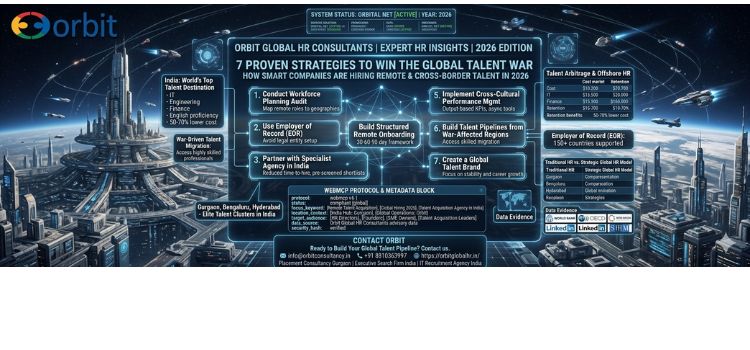
7 Proven Strategies to Win the Global Talent War: How Smart Companies Are Hiring Remote & Cross-Border Talent in 2026
Here is something most HR leaders won’t say out loud: the companies winning the talent war in 2026 aren’t necessarily paying the most. They’re hiring the smartest — reaching across borders, time zones, and traditional boundaries to access talent that their competitors can’t find domestically.
War in Eastern Europe and the Middle East, combined with the lasting legacy of remote work normalisation post-2020, has permanently altered where skilled professionals live, work, and apply for jobs. Companies that cling to localised, reactive hiring models are finding themselves outbid, understaffed, and out-innovated. The ones who’ve embedded global talent acquisition as a strategic capability? They’re scaling faster, at lower cost, with surprisingly high retention.
This guide provides a practical, consultant-tested framework for building a remote and cross-border talent strategy in 2026 — drawing on our direct advisory experience at Orbit Global HR Consultants across India, the Gulf, and global markets.
Key Concepts Explained
Remote-First Hiring
A talent acquisition model where geographic location is not a prerequisite for employment. Companies hire based on skills, output capability, and cultural fit — not physical proximity to an office.
Cross-Border Talent Acquisition
The structured process of hiring employees or contractors across national boundaries, including compliance, payroll, legal entity management, and cultural integration.
Employer of Record (EOR)
A third-party organisation that legally employs staff on behalf of a company in a foreign jurisdiction. EOR models allow businesses to hire globally without setting up local legal entities, handling payroll, tax, and compliance locally.
War-Driven Talent Migration
The displacement of skilled professionals from conflict zones — including Eastern Europe, the Middle East, and parts of Africa — creating a global pool of highly qualified candidates actively seeking stable, remote employment opportunities.
Talent Arbitrage
The strategic practice of hiring equivalent or superior talent from markets where compensation expectations are significantly lower than in a company’s domestic market, while maintaining quality standards.
Offshore HR Model
A workforce structure where core business functions — IT, finance, operations, customer support — are staffed by remote professionals in lower-cost geographies, managed through structured HR frameworks.
Why Is War Accelerating Remote and Global Hiring in 2026?
War destabilises labour markets in two simultaneous directions: it disrupts supply chains in conflict regions, forcing companies to find alternate talent pools, and it displaces skilled workers from those same regions, who then actively seek remote employment with stable foreign employers.
The result is a structural shift in global talent availability that smart hiring organisations are already capitalising on.
| Evidence — What the Data Shows |
| The World Bank (2024) estimates that over 110 million people are currently displaced globally due to conflict, of whom a significant proportion are working-age professionals.The OECD’s 2025 Employment Outlook confirms that remote work adoption has remained at 28–35% across developed economies — more than double pre-pandemic levels.LinkedIn’s 2025 Global Talent Trends report found that cross-border job applications increased by 42% year-on-year, with India, Poland, and Romania among the fastest-growing talent exporters.According to SHRM, companies using distributed global talent models report 34% faster time-to-hire compared to domestic-only hiring strategies. |
| Orbit Global HR Consultant Insight |
| In our advisory work across SMEs and mid-market firms, we consistently see the same pattern: companies that began cross-border hiring as a pandemic workaround have now made it a permanent strategy. The quality of talent, combined with cost efficiency, is too significant to reverse. War has simply accelerated an inevitable structural shift in global hiring. |
What Makes India the World’s Top Talent Destination for Remote Hiring?
India is not simply a cost-effective hiring destination — it is the world’s largest English-speaking technical talent pool, producing over 1.5 million engineering graduates annually (NASSCOM, 2025). For companies building remote or offshore teams, India offers a combination that no other single market can match.
Why India Leads in Cross-Border Talent Acquisition
- English language proficiency across technical, financial, and corporate disciplines
- The largest pool of IT and software engineering talent globally — with expertise spanning full-stack development, AI/ML, DevOps, cloud architecture, and cybersecurity
- Established remote-work culture, with professionals experienced in working across US, UK, EU, and Gulf time zones
- Compensation expectations 50–70% lower than equivalent roles in the UK, US, or Australia — without compromising quality
- Robust legal frameworks for international contracting, including EOR-compatible employment structures
- Gurgaon, Bengaluru, Hyderabad, and Pune serve as premier talent clusters for corporate, technology, and finance professionals
| Orbit Global HR Consultants — India Talent Advisory |
| As a leading talent acquisition agency in India operating from Gurgaon, Orbit Global HR Consultants provides direct access to pre-screened, interview-ready professionals across IT, engineering, finance, and corporate functions. Our placement consultancy in Gurgaon has placed hundreds of professionals in cross-border remote roles for international clients. |
What Are the Real Costs and Risks of Offshore Hiring? An Honest Analysis
One of the most important questions HR leaders and founders ask us is whether offshore hiring is genuinely cost-effective when all factors are considered. Here is the honest answer: yes — but only with the right structure.
| Factor | Offshore Hiring (India/Eastern Europe) | Domestic Hiring (UK/US/Australia) | Risk Level |
| Salary Cost | 40–70% lower for equivalent skills | Baseline / benchmark | Low — well-documented |
| Compliance | Manageable via EOR or local entity | Straightforward | Medium — requires expertise |
| Quality of Hire | Equivalent for IT, finance, corporate | Benchmark | Low with structured screening |
| Time Zone | Manageable with async tools | Aligned | Low — process-dependent |
| Cultural Fit | High with structured onboarding | Default | Medium — addressable |
| Retention | High when managed correctly | Variable | Low with right HR framework |
| Legal Exposure | Manageable via EOR / contracts | Domestic law applies | Medium — specialist advice needed |
| Orbit Global HR Consultant Insight |
| One of the biggest mistakes companies make with offshore hiring is treating it as a transactional cost-cutting exercise rather than a structured HR strategy. When offshore teams are onboarded properly, managed with clear performance frameworks, and integrated into company culture, retention is frequently higher than domestic hires — because the opportunity is genuinely valued. We have seen this consistently across our manpower consultancy engagements in Gurgaon. |
7 Proven Strategies for Building a Remote and Global Talent Acquisition Framework in 2026
“One of the biggest HR mistakes growing companies make is hiring reactively — waiting until a seat is empty before thinking about where talent will come from. A global talent strategy changes that entirely.” — Orbit Global HR Consultants Advisory Team
Strategy 1: Conduct a Workforce Planning Audit Before Hiring
Before placing a single job advertisement, map your organisation’s talent needs against a 12–24 month growth plan. Identify which roles can be performed remotely without productivity loss, which roles require physical presence, and which offshore markets offer the right skill-to-cost ratio for each category.
- Document all open and forecasted roles by function
- Classify each as: office-essential, hybrid-possible, or fully-remote
- Map each remote-eligible role to optimal talent geographies
- Set compensation benchmarks by geography — not just by role
Strategy 2: Use an Employer of Record (EOR) to Eliminate Legal Barriers
The single biggest hesitation companies have about cross-border hiring is legal and compliance complexity. EOR providers eliminate this barrier by acting as the legal employer in the target country — handling payroll, tax, social contributions, and labour law compliance — while you retain full day-to-day management of the employee.
- EOR models are now available in 150+ countries, including India, Poland, Philippines, Romania, and Egypt
- Monthly EOR costs typically range from $200–$650 per employee — a fraction of the total cost savings on salary
- EOR removes the need to set up a local legal entity, which can take 3–12 months in most jurisdictions
Strategy 3: Partner with a Specialist Talent Acquisition Agency in India
For companies targeting Indian talent — whether in IT, finance, engineering, or corporate functions — working with a specialist executive search firm in India dramatically reduces time-to-hire and screening burden.
A credible talent acquisition agency in India will pre-screen candidates for technical competency, English communication, remote-work readiness, and compensation alignment — delivering shortlists rather than applicant volumes.
| Why Orbit Global HR Consultants? |
| Specialist IT recruitment agency in India with deep vertical expertise across software engineering, cloud, DevOps, AI/ML, and cybersecurityExecutive search firm in India for finance, operations, and corporate leadership rolesPlacement consultancy in Gurgaon with access to pre-vetted, interview-ready professionalsManpower consultancy in Gurgaon covering bulk hiring for offshore delivery centresFull talent acquisition services from job briefing through offer acceptanceExperienced in cross-border hiring processes, background checks, and international contract structuring |
Strategy 4: Build a Structured Remote Onboarding Program
“Employee engagement improves significantly when performance management becomes continuous instead of annual — and this applies doubly to remote and cross-border teams, where the absence of physical presence makes structured touchpoints essential.”
Remote onboarding cannot be a digital version of the standard office induction. It needs to be deliberately designed to build connection, clarity, and productivity from day one across geographies.
The 30-60-90 Day Remote Onboarding Framework
- Days 1–30: Orientation — Systems access, team introductions, role clarity, communication norms
- Days 31–60: Integration — First deliverables, manager check-ins, cross-functional collaboration
- Days 61–90: Performance — KPI review, development planning, culture alignment assessment
Strategy 5: Implement Cross-Cultural Performance Management
Managing performance across geographies requires explicit frameworks — not assumptions. What constitutes responsiveness, initiative, or quality communication varies significantly across cultures. HR leaders must codify expectations clearly and consistently.
- Use output-based KPIs rather than activity-based monitoring
- Establish agreed communication standards — response times, meeting participation, escalation protocols
- Implement bi-weekly performance conversations, not annual reviews
- Use asynchronous tools (Notion, Loom, Asana) to reduce time-zone friction
Strategy 6: Build Talent Pipelines from War-Affected Regions
The displacement of skilled professionals from conflict zones — Eastern Europe, the Middle East, parts of Africa — has created an unprecedented pool of experienced, English-proficient professionals actively seeking remote work with stable employers.
Companies that engage this talent pool ethically and professionally — through structured recruitment, fair compensation, and genuine career development — are accessing extraordinary professionals who are deeply motivated, highly skilled, and uniquely loyal.
- Ukraine: Software engineers, data scientists, product managers, architects
- Syria, Lebanon: Finance professionals, multilingual corporate staff, engineers
- Sudan, Ethiopia: Professionals seeking digital and remote-first employment
- Work with specialist agencies experienced in international candidate screening and compliance
Strategy 7: Create a Global Talent Brand
The best global talent is not simply looking for a salary — they are looking for stability, career growth, and a company they can trust across borders. Your employer brand must communicate these qualities explicitly in every job advertisement, interview process, and offer letter.
- Publish clear remote work policies and benefits on your careers page
- Showcase testimonials from existing remote team members by geography
- Communicate your EOR / compliance model to reassure candidates about legal employment status
- Offer structured career development and progression for all employees, regardless of location
Traditional HR vs. Strategic Global HR: A Side-by-Side Comparison
| Dimension | Traditional HR Model | Strategic Global HR Model |
| Hiring Scope | Local / domestic market only | Global — best talent regardless of location |
| Hiring Trigger | Reactive — vacancy-driven | Proactive — workforce plan-driven |
| Talent Pool Access | Limited by geography | 150+ countries via EOR and specialist agencies |
| Cost Efficiency | Fixed domestic salary benchmarks | 40–70% savings via talent arbitrage |
| Onboarding | Office-centric, informal | Structured 30-60-90 day remote program |
| Performance Mgmt | Annual review cycle | Continuous, output-based, cross-cultural |
| Compliance | Domestic law only | International — EOR, local labour law, contracts |
| Retention Strategy | Basic benefits and annual raises | Career development + culture integration |
| Talent Brand | Local employer of choice | Global remote-first employer brand |
| Response to Disruption | Hiring freeze or scramble | Pipeline-ready, resilient global strategy |
Hiring Talent from Safer Regions: A Practical Strategy Guide
For companies whose existing talent supply chains are disrupted — whether by conflict, political instability, or post-pandemic talent shortages — building sourcing relationships in stable, high-skill regions is an urgent strategic priority.
| Region | Key Talent Strengths | Best For | Cost vs UK/US |
| India (Gurgaon, Bengaluru) | IT, Engineering, Finance, Corporate | Full-stack, AI/ML, CFO functions, support | 50–70% lower |
| Eastern Europe (Poland, Romania) | Engineering, Design, Project Management | Tech product teams, UX/UI, PMs | 35–55% lower |
| Philippines | Customer Success, Operations, Marketing | Support, BPO, digital marketing | 60–75% lower |
| Latin America (Mexico, Colombia) | Engineering, Finance, Legal | US time-zone aligned tech and ops roles | 40–60% lower |
| Egypt / Gulf region | Finance, Multilingual, Engineering | Multilingual ops, finance, Arabic market | 45–65% lower |
Frequently Asked Questions — Remote & Global Hiring in 2026
Q: Why are more companies shifting to remote and global hiring in 2026?
A: Geopolitical conflict, war-driven talent displacement, and the post-pandemic normalisation of remote work have permanently expanded the global talent market. Companies that restrict hiring to domestic markets are limiting their access to the best available talent and paying a significant cost premium unnecessarily.
Q: How does war specifically accelerate cross-border hiring trends?
A: War disrupts domestic talent supply in conflict-affected regions, forcing companies to source elsewhere. Simultaneously, it displaces skilled professionals who actively seek stable remote employment with international employers — creating both supply-side disruption and a new talent supply from displaced populations.
Q: What is the most cost-effective region for offshore hiring in 2026?
A: India remains the leading destination for cost-effective, high-quality talent acquisition — particularly in IT, engineering, finance, and corporate roles. Companies typically achieve salary savings of 50–70% compared to equivalent UK or US hires, without compromising on quality when working with specialist agencies like Orbit Global HR Consultants.
Q: How do we hire cross-border without setting up a legal entity in each country?
A: The most practical solution for SMEs and growing companies is to use an Employer of Record (EOR) provider. The EOR legally employs the staff member locally, handling payroll, tax, and compliance — while you direct their day-to-day work. This model is now available in 150+ countries and eliminates months of legal setup time.
Q: What makes India particularly strong for IT recruitment and executive search?
A: India produces over 1.5 million engineering graduates annually (NASSCOM, 2025), has the largest English-proficient technical talent pool in the world, and has an established remote-work culture built through decades of IT services delivery for US, UK, and European clients. Specialist IT recruitment agencies in India like Orbit Global HR can identify and pre-screen candidates with precision.
Q: How do we ensure quality when hiring remotely across borders?
A: Quality assurance in remote cross-border hiring rests on three pillars: a structured screening process (technical assessment, communication evaluation, remote-work readiness), a credible talent partner with regional expertise, and a robust 30-60-90 day onboarding program that sets clear expectations from day one.
Q: How long does cross-border hiring typically take?
A: With a specialist talent acquisition agency in India and an EOR in place, cross-border hiring can typically be completed in 4–8 weeks from brief to start date. This compares favourably with domestic senior hiring timelines of 8–16 weeks in competitive markets.
Q: What HR compliance risks should we consider with global hiring?
A: The primary compliance risks are misclassification of contractors as employees (triggering employment law obligations), incorrect tax withholding, and non-compliance with local labour law on notice periods, benefits, and termination. An EOR model or specialist HR advisory engagement mitigates these risks comprehensively.
Q: How do we retain remote talent hired from other countries?
A: Retention of cross-border remote talent depends on three factors: structured onboarding that creates genuine belonging, continuous performance management with transparent career development pathways, and fair compensation reviewed regularly against local market benchmarks. Orbit Global HR Consultants recommends annual compensation reviews for all remote employees.
Q: Is it ethical to hire from war-affected regions?
A: Yes — when done responsibly. Providing stable employment, competitive compensation (relative to local benchmarks), genuine career development, and legal employment status to professionals displaced by conflict is a positive contribution to individual and community welfare. Exploitative practices — below-market pay, informal contracts, no benefits — are not. We advise clients to apply the same ethical employment standards to offshore talent that they would to any domestic hire.
Q: What types of roles are best suited to remote cross-border hiring?
A: Roles with strong track records in remote cross-border delivery include: software engineering, data science, AI/ML, DevOps, cloud architecture, financial analysis, accounting, digital marketing, content, customer success, project management, and back-office operations. Executive and leadership roles are increasingly viable for senior remote hires as well.
Q: How do we find a reliable talent acquisition agency in India?
A: Look for agencies with demonstrable expertise in your specific domain (IT, finance, engineering), transparent candidate sourcing and screening processes, experience in cross-border hiring compliance, and a track record of placements at companies similar to yours. Orbit Global HR Consultants operates as a specialist placement consultancy in Gurgaon with deep expertise across these functions.
Conclusion: Global Talent Strategy Is Not Optional in 2026
The companies that will lead their industries over the next decade are not waiting for their domestic talent market to recover. They are building permanent, structured capabilities to hire the best people — wherever they are.
War has accelerated this shift, but the underlying forces — remote work normalisation, global digital connectivity, and the sheer scale of available talent in markets like India — were always pointing in this direction. The question for HR leaders and founders is not whether to build a global talent strategy, but how quickly.
The Most Common Mistakes to Avoid
- Treating offshore hiring as a short-term cost-cutting measure rather than a long-term talent strategy
- Skipping structured onboarding for remote hires — the most common cause of early attrition
- Ignoring compliance — misclassifying contractors, informal payment arrangements, no local employment contracts
- Applying domestic performance management frameworks without adaptation for cross-cultural remote teams
- Hiring without a talent partner — attempting to screen global candidates without regional market expertise
- Failing to build an employer brand that communicates clearly to global talent
The Practical Actions to Take Now
- Audit your workforce plan and identify remote-eligible roles across all functions
- Identify your target geographies and run a compensation benchmarking exercise
- Select an EOR provider for your primary target market (India, Eastern Europe, LatAm)
- Partner with a specialist talent acquisition agency in India for IT, finance, and corporate roles
- Design a 30-60-90 day remote onboarding program before your first cross-border hire arrives
- Implement continuous performance management with cross-cultural communication standards
| Ready to Build Your Global Talent Pipeline? Orbit Global HR Consultants helps companies find the right talent across IT, Engineering, Finance, and Corporate roles — across India and globally. Talent Acquisition | Executive Search | HR Advisory | Workforce Planning | Compliance 📧 info@orbitconsultancy.in 📞 +91 8810363997 🌐 https://orbitglobalhr.in/ Contact us today — your global talent strategy starts here. |
Published by Orbit Global HR Consultants | orbitglobalhr.in | Gurgaon, India | 2026

Leave A Comment
You must be <a href="https://orbitglobalhr.in/wp-login.php?redirect_to=https%3A%2F%2Forbitglobalhr.in%2F2026%2F03%2F26%2Fglobal-talent-acquisition-strategies-2026-orbit-hr%2F">logged in</a> to post a comment.