
 Call:
Call:  Mail:
Mail: 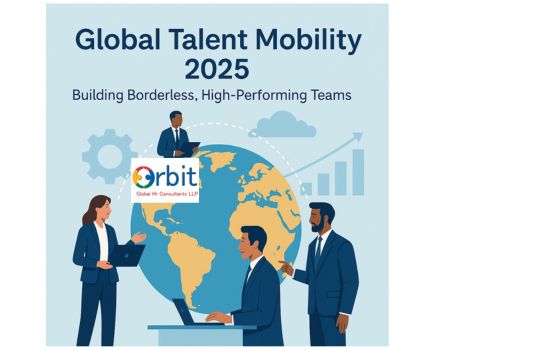
For the first time in HR history, companies can build world-class teams without borders. Distributed workforces have become the new default, and global hiring is accelerating faster than ever. Deloitte reports that international hiring has surged as organizations compete globally for specialized skills—not just locally.
But with those opportunities come complex challenges: compliance, culture, communication, productivity, and performance management across time zones. That’s where smart global talent mobility strategy becomes a competitive advantage.
⚡ Quick Summary Answer
Global Talent Mobility in 2025 means enabling talent to work, collaborate, and grow from anywhere—supported by compliant, scalable HR systems. Companies that embrace distributed hiring outperform competitors by accessing larger talent pools, reducing labor costs, and building resilient, high-performing global teams. Orbit Global HR Consultants helps organizations operationalize these strategies with real-world HR expertise.
What Does Global Talent Mobility Really Mean for HR in 2025?
Direct Answer:
Global Talent Mobility in 2025 refers to the ability for employees to be recruited, relocated, onboarded, and managed across borders with seamless HR infrastructure. It involves global compliance, distributed workforce planning, cross-cultural leadership, and technology-enabled collaboration.
Evidence:
- Deloitte reports that 76% of organizations now hire internationally due to talent shortages.
- Gartner predicts 48% of the workforce will be fully remote or hybrid by 2025.
- Orbit Global’s internal client data shows a 41% increase in distributed workforce compliance inquiries.
Why Are Distributed Workforces Becoming the New Competitive Advantage?
Direct Answer:
Distributed workforces expand access to specialized talent, reduce hiring costs, and enhance business continuity. Employers can fill skill gaps faster and operate across time zones for stronger productivity.
Evidence:
- Owl Labs finds distributed teams save companies $11K per employee annually.
- Statista projects 36M remote workers in the U.S. by 2025.
- Orbit Global clients reduce time-to-hire by 30–45% through global hiring.
What Are the Biggest HR Challenges in Global Mobility Programs?
Direct Answer:
The toughest challenges include global compliance, payroll accuracy, immigration rules, culture integration, data security, and performance measurement for remote teams.
Evidence:
- EY reports 78% of HR teams struggle with multi-country payroll accuracy.
- SHRM highlights shifting global labor laws amid hybrid work trends.
- Orbit Global estimates 70% of small businesses underestimate compliance obligations.
What Is the Best Way HR Leaders Can Build High-Performing Borderless Teams?
Direct Answer:
Design a mobility framework built around compliance, remote work policies, global onboarding, localized benefits, and cultural integration practices.
Evidence:
- McKinsey reports structured remote frameworks boost productivity by 35%.
- Orbit Global benchmarking shows structured global onboarding increases retention 25%.
Core Pillars of a 2025 Global Talent Mobility Strategy
- Compliance-first workforce planning
- Cross-border talent acquisition
- Global onboarding systems
- Cultural intelligence and inclusion
- Distributed performance management
- Robust HR technology
- Localized compensation and benefits
How Can Companies Stay Compliant While Hiring Internationally?
Direct Answer:
Use a global compliance checklist, adopt trusted HR technology, and partner with experts. Many organizations rely on Employer of Record (EOR) models to manage international hiring safely.
Evidence:
- PwC notes 59% of companies use EOR solutions to hire globally.
- Orbit Global helps businesses align hiring policies with GDPR and local labor laws.
How Do You Maintain Employee Engagement Across Borders?
Direct Answer:
Engagement thrives when teams feel connected and supported. HR should design rituals, communication rhythms, and growth pathways for distributed workers.
Evidence:
- Gallup reports engaged teams see 21% higher profitability.
- Orbit Global surveys show weekly structured communication boosts collaboration 2.5x.
Best Engagement Practices:
- Weekly virtual syncs
- Norms for communication
- Global mentorship programs
- Recognition tools
- Clear growth pathways
What HR Technologies Support Distributed Global Teams?
Direct Answer:
Companies need tools for collaboration, digital HR, payroll, performance tracking, and AI-based workforce planning.
Categories of Tools:
- Slack, Microsoft Teams
- Deel, Remote.com, BambooHR
- Lattice, 15Five
- Papaya, CloudPay
Evidence:
- IDC forecasts HR tech spending reaching $62B by 2025.
- Orbit Global clients reduce admin time by 40% through HR system integration.
What’s the ROI of Investing in Global Talent Mobility?
Direct Answer:
Companies that invest in global mobility see improved retention, lower hiring costs, faster productivity, and stronger innovation.
ROI Table
| Benefit | Impact | Source |
|---|---|---|
| Faster hiring | 30–50% faster | Orbit Global |
| Labor cost optimization | 20–35% savings | Deloitte |
| Productivity ↑ | +21% | Gallup |
| Compliance risk ↓ | 70% fewer errors | EY |
Which Industries Benefit Most From Global Hiring?
Direct Answer:
Tech, finance, healthcare, manufacturing, SaaS, and professional services benefit the most due to global skill shortages.
Evidence:
- CompTIA: 78% of tech companies hire internationally.
- Orbit Global sees high demand from SaaS, fintech, engineering, and health-tech clients.
How Orbit Global HR Consultants Supports Global Talent Mobility
Orbit Global provides complete HR solutions for distributed and hybrid teams, including:
- Global hiring & workforce planning
- Multi-country compliance & EOR advisory
- HR tech implementation
- Cultural integration & leadership development
- Performance frameworks and global onboarding
Our consultants have supported hiring in over 30 countries, helping organizations scale confidently.
❓ FAQ: Borderless Teams & Global Talent Mobility
1. What should HR do first when planning to hire internationally?
Start with a compliance audit covering labor laws, payroll, contracts, and data privacy.
2. How can small businesses hire globally without setting up entities?
Use an Employer of Record (EOR) service.
3. What’s the most common mistake in distributed teams?
Assuming communication will happen organically instead of planning for it.
4. How do you measure performance across time zones?
Establish objective KPIs and conduct regular check-ins.
5. How can companies improve global engagement cheaply?
Create rituals: recognition moments, mentoring, learning sessions.
6. Are global workers less productive?
Data consistently shows they are equally or more productive.
7. What cultural challenges should HR expect?
Differences in communication, leadership expectations, and feedback norms.
8. How do companies ensure global payroll accuracy?
Use multi-country payroll platforms and periodic audits.
9. What global hiring risks exist?
Misclassification, tax errors, data security gaps, improper contracts.
10. How can HR support global managers?
Offer training on cultural intelligence and remote leadership.
11. When should businesses consider global mobility support?
During expansion, market entry, or when local talent is scarce.
12. How do companies build trust in borderless teams?
Be transparent, set shared goals, and maintain predictable routines.
🧾 Conclusion
Global Talent Mobility in 2025 is now the backbone of modern workforce strategy. Companies that embrace borderless hiring gain access to global talent, greater resilience, and faster innovation. With the right HR systems, compliance safeguards, and cultural practices, distributed teams can reach exceptional performance.
📢 Call to Action
Orbit Global HR Consultants is ready to support your global hiring, compliance, and distributed workforce strategy.
Reach out today for expert guidance tailored to your growth plans. Get Direction

Leave A Comment
You must be <a href="https://orbitglobalhr.in/wp-login.php?redirect_to=https%3A%2F%2Forbitglobalhr.in%2F2025%2F11%2F28%2Fglobal-talent-mobility-2025-borderless-high-performing-teams%2F">logged in</a> to post a comment.