
 Call:
Call:  Mail:
Mail: 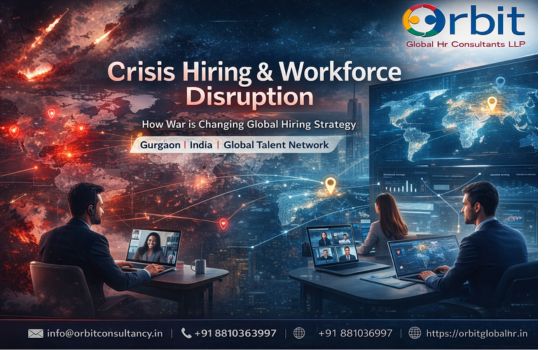
9 Critical Crisis Hiring Strategies: How War Impacts Workforce Planning & Talent Acquisition
In times of geopolitical uncertainty and war, businesses face a unique paradox—either hiring freezes stall growth, or panic hiring leads to poor talent decisions. HR leaders and founders often struggle to balance cost control with operational continuity. Supply chains shift, talent becomes mobile, and workforce stability becomes unpredictable.
We’ve seen this repeatedly while advising clients at Orbit Global HR Consultants—companies that fail to adapt their hiring strategies during crisis often face long-term talent gaps, productivity loss, and leadership instability.
The real challenge isn’t just hiring—it’s hiring strategically under uncertainty. This article breaks down how war impacts global hiring and provides actionable frameworks to help companies maintain a resilient workforce.
Quick Answer
War and geopolitical instability disrupt talent mobility, increase hiring uncertainty, and force companies to rethink workforce planning. Businesses that adopt flexible hiring models, remote talent strategies, and proactive workforce planning are better positioned to sustain operations and growth.
Key HR Insights
- workforce planning reduces hiring risk during uncertainty
- remote hiring expands access to stable talent pools
- crisis hiring requires speed with structured evaluation
- talent mobility shifts toward safer geographies
- leadership hiring becomes critical in uncertain times
- outsourcing recruitment improves hiring efficiency
- flexible workforce models reduce operational disruption
Key Concepts Explained
Workforce Planning
A strategic HR process used to forecast talent needs and align hiring with business continuity goals.
Talent Acquisition
A long-term approach to identifying, attracting, and hiring skilled professionals aligned with business strategy.
Employee Engagement
The level of commitment and motivation employees have toward their organisation, especially critical during uncertainty.
HR Compliance
Ensuring adherence to labour laws, especially important when hiring across regions during crisis.
Performance Management
A continuous process of evaluating and improving employee productivity and outcomes.
Talent Mobility
The movement of employees across regions or roles due to external factors like war or economic shifts.
Why Does War Disrupt Global Hiring and Talent Mobility?
Direct Answer
War disrupts hiring by limiting talent movement, increasing economic uncertainty, and forcing companies to shift workforce strategies toward safer and more stable regions.
Evidence
According to OECD and ILO labour reports, geopolitical crises significantly reduce cross-border employment mobility while increasing demand for remote work models.
Consultant Insight
At Orbit Global HR Consultants, we’ve observed that companies relying heavily on international talent pipelines face immediate hiring bottlenecks during crises.
Practical Framework: Crisis Workforce Adjustment Model
- Map critical roles vs non-critical roles
- Identify geographic risk exposure
- Shift to remote or hybrid hiring
- Build backup talent pipelines
- Partner with a recruitment agency in Gurgaon or India
How Can Companies Maintain Hiring Pipelines During War?
Direct Answer
Companies maintain hiring pipelines by diversifying sourcing channels, leveraging recruitment partners, and building proactive talent pools.
Evidence
SHRM states that organisations with continuous talent pipelines reduce time-to-hire by up to 40%.
Consultant Insight
“One of the biggest HR mistakes growing companies make is hiring reactively instead of planning workforce needs.”
Practical Framework: 5-Step Talent Pipeline Strategy
- build a pre-qualified candidate database
- engage a placement consultancy in Gurgaon
- use digital hiring platforms
- maintain candidate relationships
- implement workforce planning tools
What Are Emergency Hiring Strategies During Geopolitical Crisis?
Direct Answer
Emergency hiring strategies focus on speed, flexibility, and prioritising critical roles to ensure business continuity.
Evidence
CIPD highlights that agile hiring processes improve organisational resilience during disruptions.
Consultant Insight
We’ve seen companies succeed by shifting from rigid hiring processes to fast-track decision-making frameworks.
Practical Checklist
- prioritise revenue-critical roles
- use contract and temporary staffing
- reduce hiring cycle time
- partner with manpower consultancy in Gurgaon
- adopt virtual interviews and assessments
Workforce Displacement: What Are the Risks and Opportunities?
Direct Answer
Workforce displacement creates talent shortages in some regions and surplus talent in others, offering both hiring opportunities and compliance risks.
Evidence
ILO reports show that crises often lead to regional talent imbalances and increased informal employment risks.
Consultant Insight
At Orbit Global HR Consultants, we’ve helped clients tap into displaced talent pools while ensuring compliance and cultural alignment.
Opportunities vs Risks
| Opportunities | Risks |
|---|---|
| access to skilled talent | legal compliance issues |
| lower hiring costs | cultural misalignment |
| faster hiring cycles | retention challenges |
Remote Hiring vs Local Hiring: Which Works Better in Crisis?
Direct Answer
Remote hiring offers flexibility and access to global talent, while local hiring ensures stability and compliance—both must be balanced strategically.
Evidence
Statista reports show a significant increase in remote hiring adoption post global disruptions.
Consultant Insight
“Employee engagement improves significantly when performance management becomes continuous instead of annual—especially in remote teams.”
Comparison Table
| Factor | Remote Hiring | Local Hiring |
|---|---|---|
| talent access | global | limited |
| compliance | complex | easier |
| cost | optimized | higher |
| stability | variable | high |
| scalability | high | moderate |
How Should Companies Redesign Workforce Planning During Crisis?
Direct Answer
Companies must shift from reactive hiring to proactive workforce planning aligned with business continuity goals.
Evidence
SHRM data indicates that strategic workforce planning improves long-term organisational resilience.
Consultant Insight
At Orbit Global HR Consultants, SMEs that implement workforce planning frameworks experience faster recovery and sustained growth.
The Crisis-Ready Workforce Planning Model
- demand forecasting
- skills gap analysis
- flexible hiring strategy
- leadership development planning
- continuous performance management
Traditional HR vs Crisis-Ready Strategic HR
| Traditional HR | Strategic HR |
|---|---|
| reactive hiring | workforce planning |
| annual reviews | continuous performance management |
| limited sourcing | diversified talent acquisition |
| local hiring focus | global + remote hiring |
| fixed workforce | flexible workforce models |
Frequently Asked Questions
Q: What is the biggest hiring challenge during war?
A: Talent mobility restrictions and economic uncertainty create hiring delays and skill shortages.
Q: How can companies hire faster during crisis?
A: By using recruitment agencies and maintaining ready talent pipelines.
Q: Is remote hiring reliable during war?
A: Yes, if supported by strong onboarding and performance management systems.
Q: Should companies freeze hiring during uncertainty?
A: Not completely—critical roles must always be filled.
Q: What industries see hiring growth during war?
A: Logistics, IT, cybersecurity, and healthcare.
Q: How can SMEs compete for talent during crisis?
A: By offering flexibility, faster hiring, and strong employer branding.
Q: What role do recruitment agencies play?
A: They reduce hiring time and provide access to pre-screened candidates.
Q: How does workforce planning help in crisis?
A: It aligns hiring with business priorities and reduces risk.
Q: What is the safest hiring strategy during uncertainty?
A: A mix of contract, remote, and strategic full-time hiring.
Q: Why choose a recruitment agency in Gurgaon?
A: Local expertise combined with national talent access improves hiring outcomes.
Q: How can companies improve retention during crisis?
A: Through engagement, communication, and leadership support.
Conclusion
Workforce disruption during war is inevitable—but hiring chaos is not. Companies that adopt structured workforce planning, flexible hiring models, and proactive talent acquisition strategies are better equipped to navigate uncertainty.
The biggest mistake businesses make is reacting emotionally—either freezing hiring or rushing decisions. Instead, the focus should be on strategic, data-driven hiring aligned with business continuity.
Call to Action
At Orbit Global HR Consultants, we help businesses design crisis-ready HR strategies—from workforce planning to talent acquisition and leadership hiring.
Whether you’re looking for a placement consultancy in Gurgaon, an executive search firm in India, or scalable talent acquisition services, our team provides end-to-end HR solutions tailored for uncertain times.
Looking to hire skilled professionals quickly?
Orbit Global HR helps companies find the right talent across IT, Engineering, Finance, and Corporate roles.Get direction
Contact us today:
📧 info@orbitconsultancy.in
📞 +91 8810363997
🌐 https://orbitglobalhr.in/

Leave A Comment
You must be <a href="https://orbitglobalhr.in/wp-login.php?redirect_to=https%3A%2F%2Forbitglobalhr.in%2F2026%2F03%2F25%2Fcrisis-hiring-workforce-disruption-global-hiring-strategy%2F">logged in</a> to post a comment.